
Distinguishing AI and ML
Syllabus alignment
This lesson supports the NSW Software Engineering Stage 6 syllabus:
-
Software automation / Algorithms in machine learning
- Distinguish between artificial intelligence (AI) and ML.
Automation is everywhere: from self‑checkout at supermarkets to spam filters in email and smart recommendations in apps. Organisations such as banks, retailers, and tech companies increasingly use Artificial Intelligence (AI) and Machine Learning (ML) to deliver services faster, detect fraud, and improve customer experiences. This topic provides the foundations you need before we build and test simple ML-powered automations in class.
The difference between AI and ML
Artificial Intelligence (AI) aims to enable computers to perform tasks that typically require human intelligence, perception, reasoning, decision-making, and communication. AI can be built using techniques such as rules and knowledge bases, search and optimisation, planning, and machine learning. Examples include rule‑based expense approval checks, game‑playing agents, and chatbot dialogue managers.
Machine Learning (ML) is a subfield of AI in which systems learn patterns from data to improve performance on a task without being explicitly programmed with every rule. Applications include training models from data for spam filtering, demand forecasting, anomaly detection on logs/metrics, and document classification.
AI and ML work together
AI is the umbrella. AI is a broad field encompassing systems designed to perform tasks that typically require human intelligence. AI can be built using various approaches, including rule-based systems (using predefined rules and logic), search algorithms, machine learning (ML), or combinations of these methods.
ML continuum
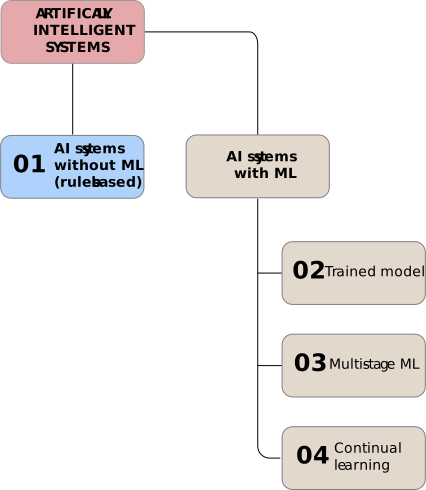
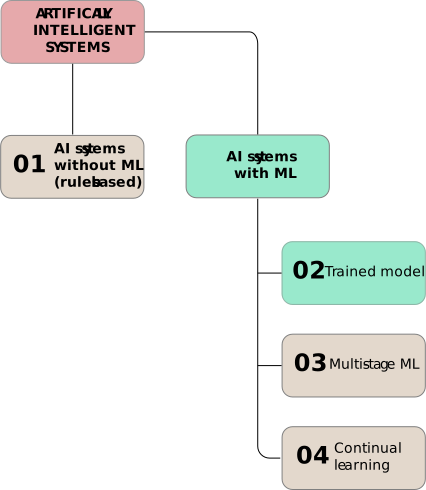
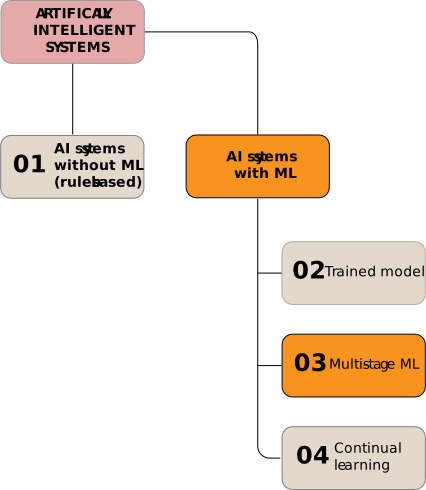
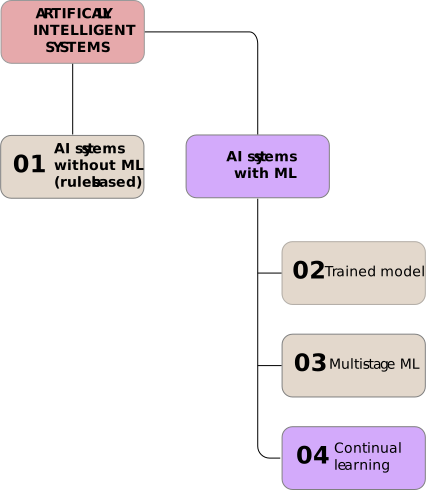
ML can be applied at various stages of system development and use, and the interactive below shows that continuum for an AI system used for plant identification.
01 Rule-based key (no ML)
User answers a series of taxonomic questions; the system follows fixed rules to reach an outcome.
- Uses fixed IF/THEN rules to guide users through decision paths; every outcome is scripted ahead of time.
- Feedback is logged for later human review, but no automatic learning occurs until editors revise the rules offline.
- Operates entirely on provided answers; logs help instructors audit unusual cases.
- Brittle with messy inputs, requiring periodic human maintenance and QA to stay reliable.
02 Trained model
Pre-trained classifier predicts species from a photo without changing after deployment.
- A static model (e.g. CNN) converts images to features and predicts species using stored weights.
- Retraining happens in scheduled engineering cycles using curated data; users’ uploads can seed future updates.
- Runs inference quickly without storing data unless consented; pipelines swap new weights when retrained.
- Dashboards monitor bias and drift; human experts review uncertain or sensitive predictions.
03 Multi-stage ML
Pipeline chains models (e.g., detection → classification → post-processing) for refined output.
- An orchestrator first classifies broad traits, then routes cases to specialised sub-models for refined scoring.
- Data flows through multiple coordinated pipelines; automated checks catch low-confidence routes.
- Each stage retrains on new labelled slices during MLOps rotations, with drift alerts for behaviour shifts.
- Fallback rules and human oversight handle misrouted or uncertain samples.
04 Continual ML
System incorporates user feedback and new data to improve over time.
- A static model (e.g. CNN) converts images to features and predicts species using stored weights.
- Retraining happens in scheduled engineering cycles using curated data; users’ uploads can seed future updates.
- Runs inference quickly without storing data unless consented; pipelines swap new weights when retrained.
- Dashboards monitor bias and drift; human experts review uncertain or sensitive predictions.
Key terms
- Artificial intelligence (AI)
The broad field of creating machines that simulate human intelligence. - Machine learning (ML)
A type of AI where systems learn and improve from data without being explicitly programmed. - Algorithm
A set of instructions that a computer follows to solve a problem. - Automation
Technology that performs tasks with minimal human intervention.
Summary
AI is the broad goal of intelligent systems, while ML is a way to achieve AI by learning from data.